|

History of Clan MacEwen(Ewen) / MacEwan(Ewan)
Clan MacEwen: in Gaelic MAC EOGHAIN, "born of the yew tree."
The MacEwens, like the MacNeills, are descended from Aodh Anrothan (Hugh the Solitary), who relocated from Ireland to Scotland in the early eleventh century, and married an heiress of Cowal and Knapdale. Four generations later, one of his descendants, Suibhne (Sween) held Castle Sween, the "Key to Knapdale."
What with one thing and another, in the next century, the lands of Knapdale went to the Earl of Monteith; the MacSweens backed King Edward of England in the Scottish War of Independence, and therefore were dispossessed by Robert the Bruce. In the 1300s, another descendent, now called "Ewen" had established a base on Loch Fyne, in land between that of the Lamonts and the MacLachlans. At this point, the head of the clan was known as "MacEwen of Ottir."
In 1432, Swene MacEwen, 9th chief of Clan MacEwen, granted his lands to Duncan Campbell of Loch Awe following an outstanding debt, and resigned his Barony of Otter to the King of Scotland. The displaced MacEwens became a protectorate of the MacLachlans.
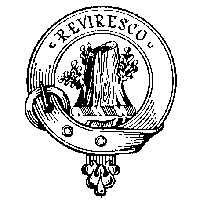
The crest, of the present McEwen baronet of Bardrochat in Ayrshire, is the stump of a cut down oak tree, sprouting forth young branches. The motto, REVIRESCO, means "I will grow again."
Although of ancient origin there are few authentic records of Clan MacEwen. Skene, quoting the manuscript of 1450, shows that the Clan Ewen together with the Clan Neill and the Clan Lachlan formed the Siol Gillevray of the Gallgael. The genealogy in the manuscript proved the Clan MacEwen existed long before 1450 and that they were known as the MacEwens of Otter. In 1794, the Rev. Alexander McFarlane wrote in his Statistical Account of the parish of Kilfinnan: "On a rocky point on the coast of Lochfyne about a mile below the church is to be seen the vestige of a building called Caesteal Mhic Eobhuin or MacEwen's castle ... this MacEwen was the chief of a clan, and proprieter of the northern division of the parish called Otter."
Eoghain na h-Oitrich (Ewen of Otter), who gives his name to the clan, lived at the beginning of the 13th century. Gillespic, 5th of Otter, flourished about a century later. Swene MacEwen, 9th and last of Otter, granted lands of Otter to Duncan Campbell in 1432 and resigned the barony of Otter to james I, but is was returned to him with reamined to Celestine, son and heir of Duncan Campbell of Lochow. In 1513 James V confirmed the barony of Otter to Colin, Earl of Argyll, and thereafter Otter remained in the possession of the Campbells.
Clan Ewen was now a "broken" clan, without a Chief, a single homeland, a stronghold or archives. A large number of MacEwens settled in the Lennox country, others went farther afield to Lochaber, Perth, Skye and the records. In 1576 two Cameron brothers were denounced for the murder of Donald Dow McKewin. An indictment was drawn up in 1598 against some 200 MacEwens, described as broken Highland men and trespassers, making a living by brigandage.
But like the MacGregors, the MacEwens also made a contribution to Highland civilization of which the Scottish government and universities knew nothing. They became bards to the Campbells of Argyll and of Breadalbane and to MacDougall of Dunollie. Amongst the relics of their art is the poem which Neil MacEwen composed in 1630 upon the death of Sir Duncan Campbell of Glenorchy; his autograph copy is preserved by the house of Breadalbane. John Campbell of Islay found in Cawdor Castle a genealogy dated 1779, which contained this explanation: "In the following account we have had regard to the genealogical tree done by Neil MacEwen, as he received the same from Eachann MacEwen his father, as he had the same from Arthur MacEwen his grandfather, and their ancestors and predecessors, shennachies and pensioners to great families who, for many ages were employed to make up and keep such records in their accustomed way."
Of the four MacEwens mentioned as having risen for Bonnie Prince Charlie in "The '45," two came from Stirling, one from Perth and one from Dundee. One of the most distinguished of their name in this century, Sir Alexander MacEwen, the Scottish Nationalist, was Provost of Inverness, the Highland capital.
Source:
Clan MacLachlan Western USA
|